The Q1 Financing Checklist That Drives More Equipment Sales
Q1 does more than open the calendar. It sets the operational tone for everything that follows.
Budgets are refreshed, growth plans are being finalized, and many buyers are actively evaluating equipment investments. Yet even in this high-intent window, vendors often lose early momentum because financing is available but not fully integrated into the sales process.
Having financing available is not the same as using it strategically.
When financing is visible, embedded, and introduced early, it does more than help buyers pay. It accelerates decisions, increases deal size, and heads off price objections before they emerge. The difference between a reactive financing program and a proactive one often determines how strong your first quarter (and the rest of your year) actually becomes.
Why Early-Year Financing Integration Matters
In Q1, buyers are thinking about expansion, efficiency, and competitive positioning. They may have new budgets, but they are still cautious about cash flow and capital allocation.
Most price objections are not about cost alone. They are about uncertainty.
When buyers are presented with a large total investment and no payment context, hesitation increases. When that same investment is framed as a clear monthly payment, the decision becomes easier to evaluate and justify. Financing shifts the conversation from “Can we afford this?” to “Does this payment support our growth plan?”
That reframing directly impacts close rates.
The Q1 Financing Optimization Checklist
To ensure your financing program supports growth beyond the first quarter, review these five areas now.
Include Financing on Every Quote
If financing appears only after a buyer hesitates, it is positioned as a rescue tactic. When monthly payment options are presented alongside total price from the beginning, affordability becomes part of the initial conversation.
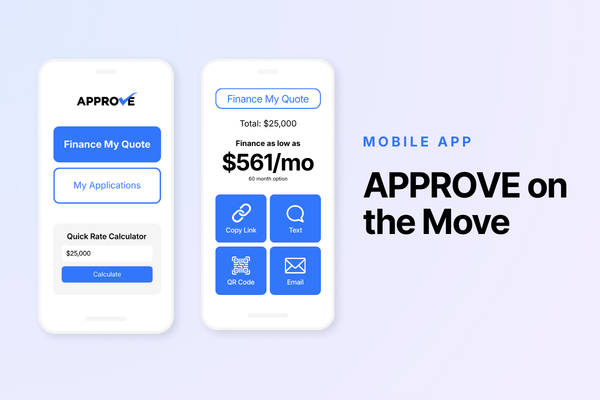
Using tools like Finance My Quote or embedding your Financing Landing Page in your quote template ensures consistency across every proposal. Establishing this habit in Q1 means your team carries it forward automatically, reducing price friction in every quarter that follows.
Make Financing Easy to Find on Your Website
Most buyers are doing their homework before they ever talk to your sales team. By the time they reach out, they have already compared vendors, pricing, and options.
If financing is hard to find on your website, you are missing a key moment to shape that evaluation. Adding your Financing Landing Page to your primary website navigation ensures buyers see affordability options while comparing vendors.
When buyers can clearly see payment options upfront, you position your company as accommodating, transparent, and growth-oriented.
Enable Embedded Financing on Product Pages
Your website should do more than display equipment. It should generate qualified leads.
When buyers can see real-time monthly payment estimates directly on product pages, they quickly understand affordability and are more likely to take action. Engaging with financing options or starting an application signals real purchase intent, not casual browsing.
By enabling the APPROVE eCommerce plugin and adding the script to your site header, financing becomes a built-in lead capture tool. Your product pages start converting traffic into applications, and applications into high-intent sales conversations.
Equip Every Sales Rep to Offer Financing
Financing should never depend on one person.
If you have added new sales reps or team members, make sure they are set up in APPROVE immediately. When every rep can confidently introduce financing early in conversations, it becomes part of your sales culture, not an afterthought.
Consistency matters.
The vendors who win in Q1 and beyond are the ones whose entire team presents financing as a standard part of every opportunity.
What This Looks Like in Practice
Consider two vendors offering similar equipment at comparable price points.
Vendor A mentions financing only when a buyer hesitates, while Vendor B includes monthly payments on every quote, highlights financing on their website, embeds payment estimates on product pages, and trains every rep to position affordability early.
Vendor B closes faster.
Vendor B increases average deal size.
Vendor B reduces price objections.
The distinction is not access to financing but the level of integration within the sales process.
Financing as Sales Infrastructure
Financing is often treated as a feature, but its true impact is structural. When implemented strategically, it shapes buyer perception, shortens decision cycles, and increases consistency across your team’s performance.
APPROVE is designed to support that shift. As a tech-forward platform with smart lender matching, it helps you streamline applications, present clear payment options, and connect buyers to competitive financing sources without burying your team in paperwork or chasing applications.
The Bottom Line
The vendors who embed financing early and consistently do not just close more deals in the first quarter. They create a repeatable system that supports growth all year.
You do not need a new sales strategy, you just need to fully activate the one you already have.